A FOCUS ON ANDREJ KOSTIĆ
The Target Forward

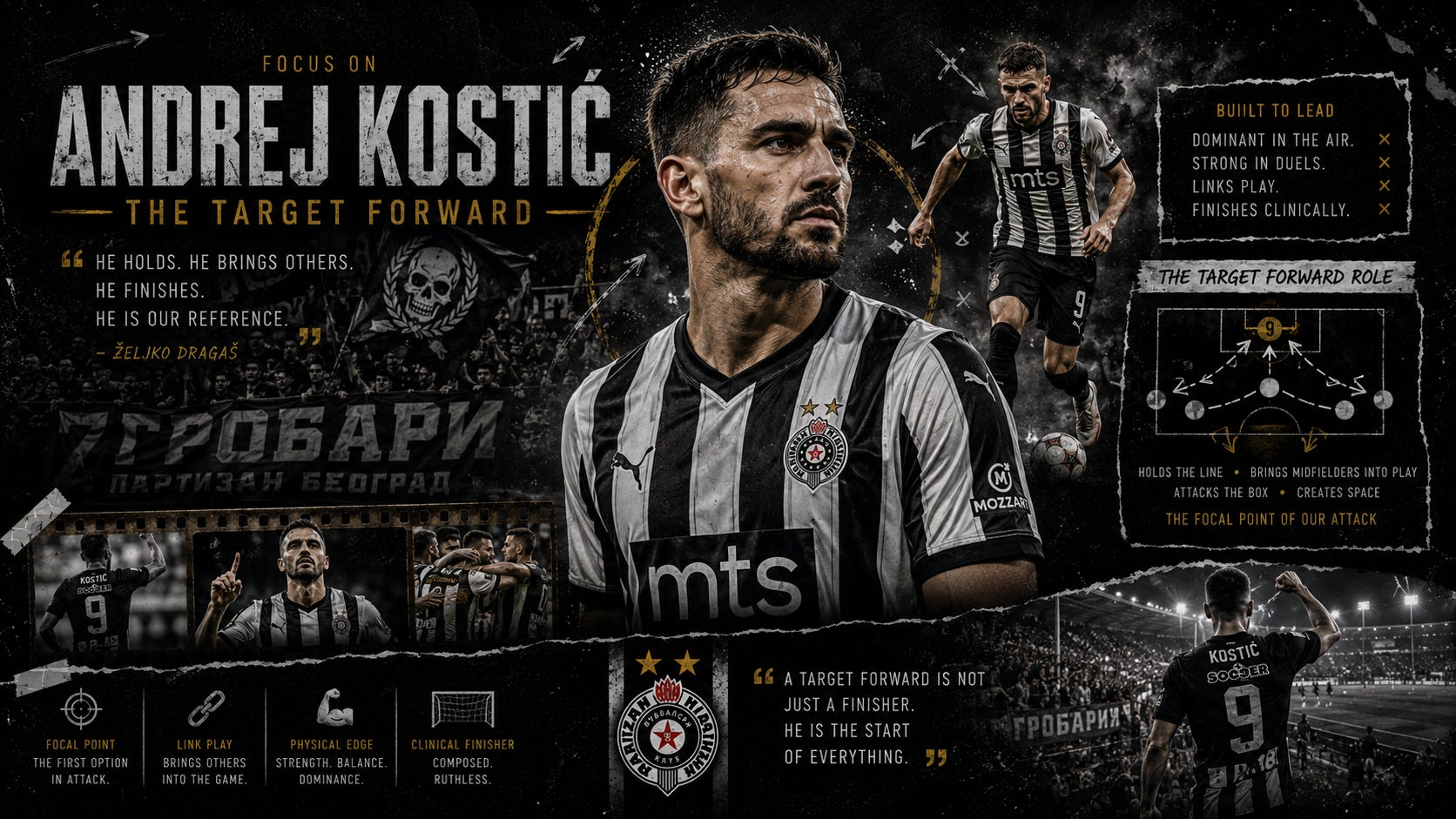
Raised within the academy system of FK Budućnost Podgorica, Kostić’s rise has felt less like a breakthrough and more like the natural continuation of a trajectory established long before senior football. Even at youth level, he consistently separated himself through a blend of physical maturity, penalty-box instinct, and composure beyond his years. During the 2024–25 campaign, his reputation accelerated dramatically in the UEFA Youth League, where a sensational hat-trick announced him to a far wider audience and firmly placed him on the radar of clubs across the region. For many observers, it was not simply the goals themselves that stood out, but the variety within them — evidence of a striker capable of adapting to different defensive situations rather than relying on a single strength.
That rapid development ultimately convinced FK Partizan to invest close to one million euros to bring him to Belgrade, and the early returns have already justified the gamble. His debut could scarcely have been scripted more dramatically: a hat-trick against FC Prishtina in UEFA Europa League qualifying immediately elevated expectations, before he followed it with the winning goal on his league debut against FK Čukarički. Since then, Kostić has maintained remarkable consistency, scoring 12 goals in 12 European appearances alongside eight goals in 15 domestic league matches — numbers that underline not only his finishing quality, but also his ability to perform under pressure on bigger stages.
Internationally, his progression has mirrored his club development. After advancing through Montenegro’s youth setup, Kostić quickly made the jump to both the U21 and senior national teams, notably scoring against Italy national under-21 football team at U21 level. Technically, he profiles as a modern central striker built to lead the line physically while still contributing structurally to attacking play. His aerial ability and upper-body strength allow him to dominate direct situations, while his tendency to play with his back to goal gives Partizan a reliable focal point capable of linking attacks and bringing runners into play. Combined with his instinctive movement inside the penalty area, it is easy to understand why he is increasingly viewed as one of the most promising attacking talents in Montenegrin football.
ANDREJ KOSTIĆ THE TARGET FORWARD
The role in Football Manager is described as: Heavily utilising their physicality and height to disrupt the oppositions defence and create goal scoring opportunities for their team, the Target Forward is typically the team’s attacking outlet during the build-up phase, and are often the target of longer passes and clearances that they can knock down, flick on, or lay off to their surrounding teammates.
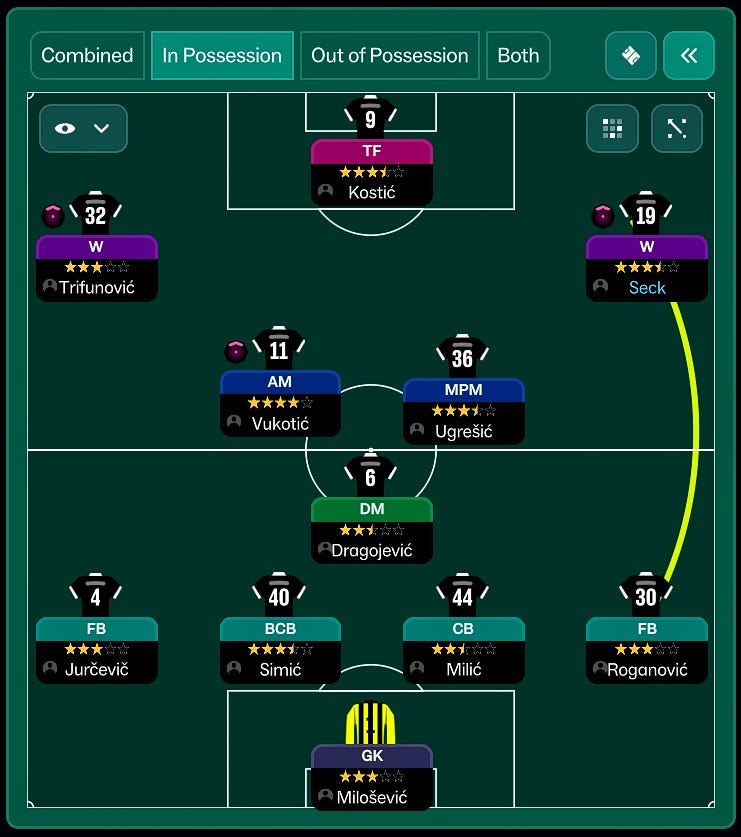
In order to get the best out of Andrej Kostić in this target man-focused 4-3-3, the central striker is naturally expected to be one of the primary sources of goals. Yet no effective attacking structure can rely entirely upon a single player carrying the scoring burden, regardless of individual quality. The real strength of a target man-led system lies not simply in what the striker scores himself, but in the opportunities he creates for everyone around him. By occupying centre-backs physically, securing direct passes, and linking play with his back to goal, the target forward becomes the reference point through which the entire attacking structure can function.
That dynamic allows the system to generate secondary goalscorers rather than forcing attacks into predictable patterns. Here at Partizan those players are the wingers Trifunović and Seck (both playing with their stronger foot on the inside) who can attack the spaces created by defenders collapsing toward the striker, and the Vukotic as the attacking midfielder who can arrive into the box against unsettled defensive lines, and overlapping players (full-backs) can exploit overloads formed through the target man’s hold-up play. In many ways, the role is less about static aerial football and more about manipulation — using the striker as a gravitational force that creates movement and uncertainty around him. When functioning correctly, the target forward is not isolated at the top of the system; he is the platform that elevates the productivity of the entire front line.
I have also added a few additional player instructions to help with both the supply (getting the ball to the Target forward) and demand (those who demand the ball from the Target Forward.
Supply
Right Fullback, as a cross from deeper/byline position.
Winger, as a cross from a more advanced position.
Midfield Playmaker, as central through balls.
Demand
Demba Seck goal threat running from the right flank.
Milan Vukotić, goal threat running from a central position. (Trait - Arrives Late In Opponents’ Area)
Nemanja Trifunović, goal threat running from the left flank. (Trait - Cuts Inside From Left Wing)
A DELVE INTO THE DATA
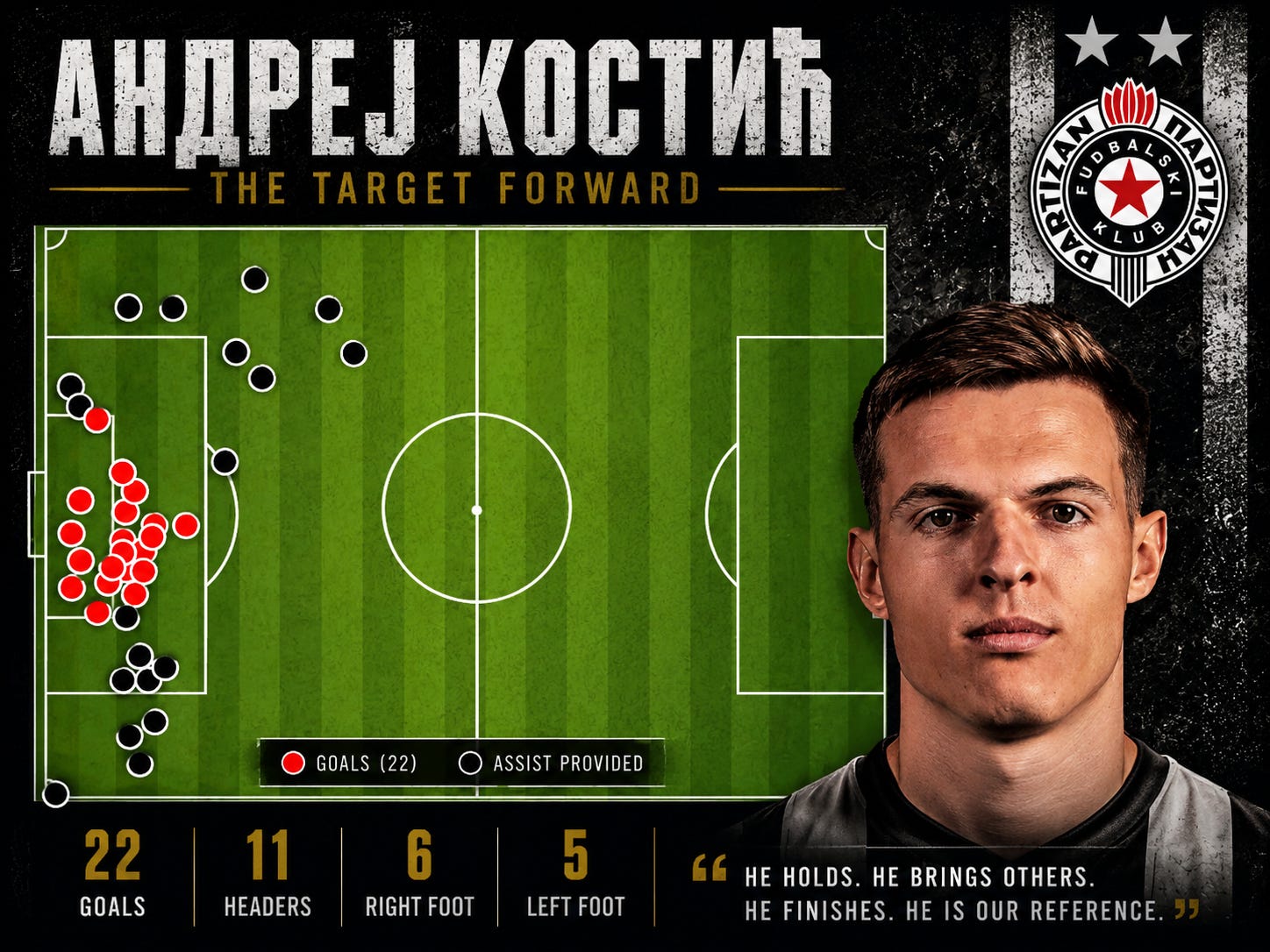
The shot map of Andrej Kostić (yes I am sad and manually plotted each point) reveals almost everything about his function within the Black Wall system. This is not the profile of a striker who drifts into wide channels or relies on speculative efforts from distance. Instead, Kostić operates as a true reference point — a penalty-box forward whose movements are designed around occupation of the central corridor and relentless presence inside high-value scoring areas. Of his 22 goals, the overwhelming majority arrive from inside the width of the six-yard box or within close proximity to the penalty spot, underlining the efficiency of both his movement and the service structure around him. The sheer concentration of red markers around the near-post and central zones reflects a striker constantly attacking crosses, second balls and cut-backs rather than manufacturing chances individually.
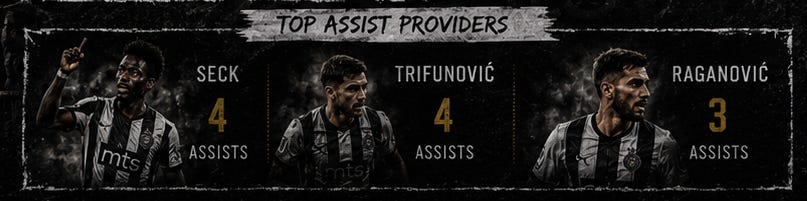
The distribution of assists further reinforces the tactical identity of the Black Wall. Wide players dominate the creative supply line, particularly Seck and Trifunović, who have each contributed four assists to Kostić. Roganović adds another three from deeper wide areas, illustrating how the system funnels progression towards crossing opportunities and vertical delivery into the striker. The black markers show consistent service arriving from half-spaces and wide channels rather than intricate central combinations. This aligns perfectly with the ideological principles of Željko Dragaš’ tactical structure: stretch the opposition horizontally before attacking the central zone with speed and aggression.
One of the defining features of Andrej Kostić within the Black Wall structure is his ability to manipulate central space without ever fully disconnecting from the penalty area. The image captures a familiar pattern within Željko Dragaš’ attacking framework: Kostić dropping away from the defensive line into the space between opposition midfield and defence. Rather than remaining fixed against centre-backs, the added Roam From Position instruction encourages him to drift into these interior pockets where he can receive under less immediate pressure and become the focal point of progression.
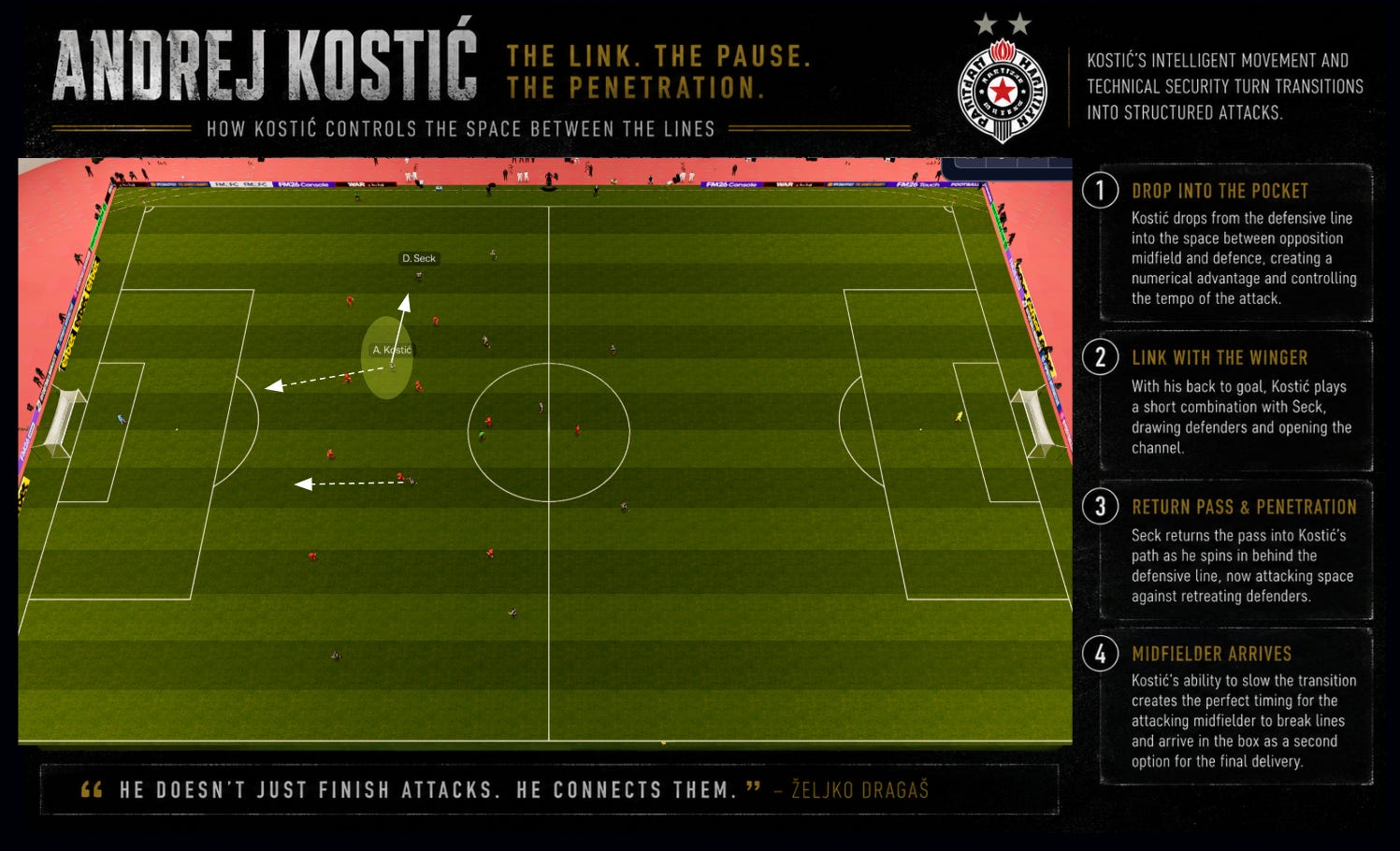
What makes this movement so effective is the way it destabilises the opposition’s defensive chain. The moment Kostić drops short, defenders are forced into a decision they rarely want to make. If a centre-back follows him into midfield, space immediately opens behind the line for runners attacking depth. If they hold position, Kostić receives freely with his back to goal — arguably the strongest aspect of his game. From these zones he becomes less of a traditional striker and more of a connective reference point, capable of slowing the attack momentarily before accelerating it again with a simple lay-off or disguised return pass.
The relationship with Seck is particularly important here. The winger’s positioning high (due to being a wide outlet winger OOP) and narrow allows him to attack the channel immediately once Kostić receives between the lines. The visual demonstrates the sequence perfectly: Kostić drops into the pocket, combines centrally and then immediately spins into the space created behind the retreating defensive line. Because defenders are momentarily occupied by the initial reception, the return pass often arrives against a disorganised back line rather than a settled defensive structure. It is a simple mechanism on paper, but within the rhythm of the Black Wall it becomes extremely difficult to defend repeatedly.
The same principle extends to the attacking midfielder operating underneath him. One of the understated qualities in Kostić’s game is his ability to control the tempo of transitional attacks. Rather than forcing immediate verticality every time possession is regained, he frequently pauses the transition just long enough for midfield runners to arrive into dangerous zones. This delay is crucial. It gives the attacking midfielder time to break beyond the opposition midfield line and attack the box from deep — often arriving untracked because defensive attention remains fixed on Kostić himself.
In many ways, this is what separates Kostić from a purely physical target forward. His role is not simply to win aerial duels or occupy centre-backs, but to orchestrate the timing of attacks within Dragaš’ structure. The Black Wall may be built on aggression and verticality, but its attacking mechanisms still rely heavily on coordination, spacing and manipulation of defensive reactions. Kostić acts as the central hinge connecting those ideas together.
The rest of ‘Grobar - The Partizan Save’ can be found over on the SI Forum if you aren’t already following along. For more frequent updates on this save you can hit the follow button in the below link and choose how you’d like to receive udates on the save.